Remembers the person
Combines local session context with long-term database memory. Sudogary can retain preferences and behaviors—from nicknames to always preparing recipes for two.
Independent project · Active development
PERSONAL AI / CASE STUDY
A modular personal AI platform with an avatar, persistent memory, specialized services, and secure home automation—built to be useful without making advanced AI expensive. The custom wake-word model runs locally in the DJ booth; other computers use a button and push-to-talk.
.png)
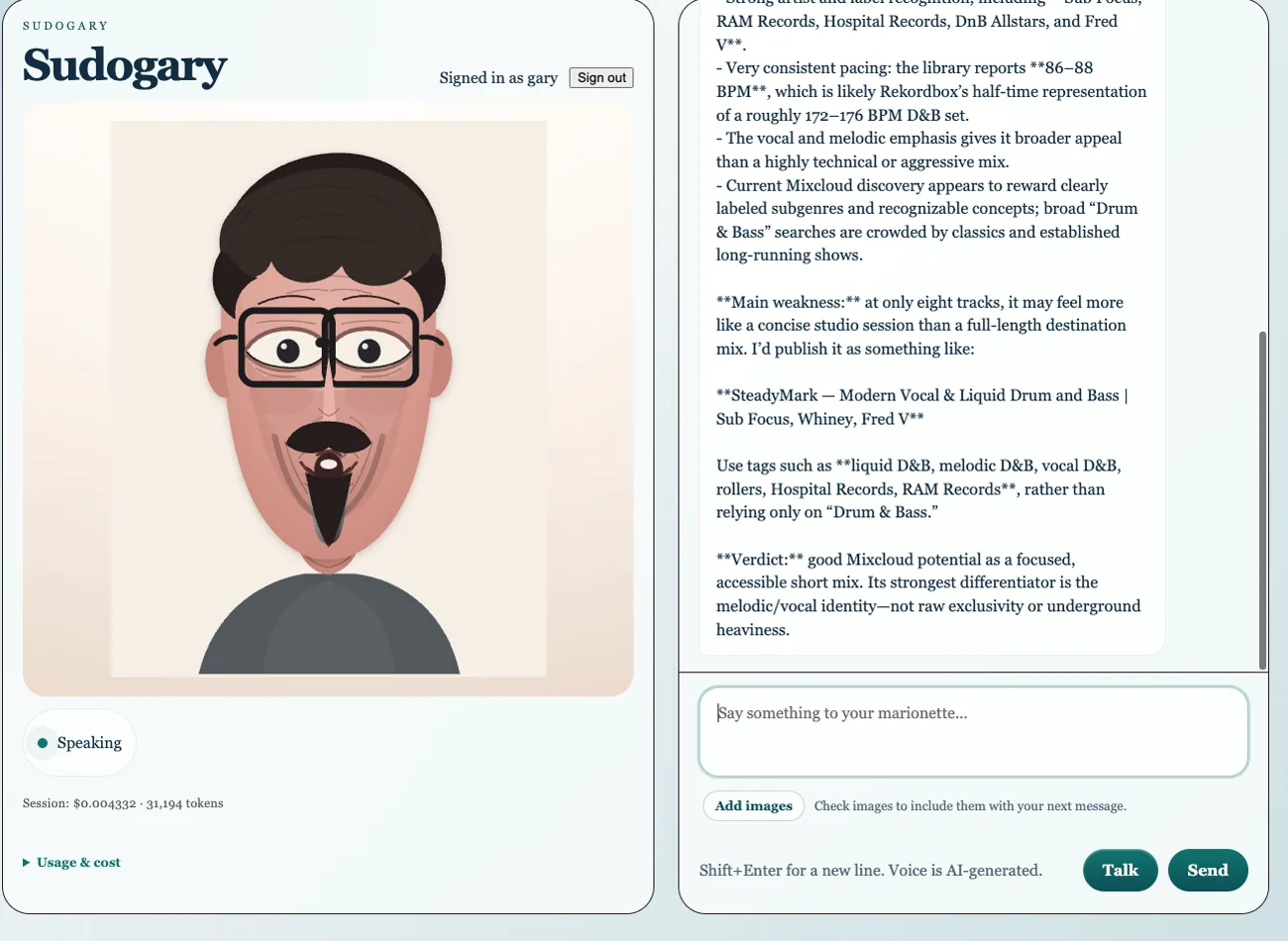
These are unfiltered demonstrations of the working system: one shows Sudogary orchestrating the physical DJ environment, while the other captures him analyzing a real Mixcloud set in conversation.
A wake word and one request activate the booth’s coordinated equipment, lighting, displays, audio, and cooling.
Mid-conversation, Sudogary evaluates pacing, BPM interpretation, artists, subgenre positioning, tags, and Mixcloud potential.
COST-AWARE BY DESIGN
Sudogary uses compact context, efficient models for routine conversation, and selective escalation when a task requires deeper reasoning.
Usage snapshot from the working Sudogary interface. API pricing and model selection can change over time.
Sudogary began with a practical question: what if a personal assistant could understand not only a request, but the person making it—and reach the right private tool without forcing every interaction through the most expensive model?
The result is a chatbot with interchangeable visual and voice “skins,” a central orchestration layer called ChatCentralCore, and a growing collection of focused services. A chef can look and sound completely different from Sudogary while using the same underlying intelligence.
Routine requests stay lightweight. Deeper reasoning is available when the conversation actually needs it.
Combines local session context with long-term database memory. Sudogary can retain preferences and behaviors—from nicknames to always preparing recipes for two.
Images can be pasted into a conversation, selected again later, and referenced as part of future questions within the session.
Connects conversational intent to Home Assistant so spoken requests can operate coordinated groups of devices and report completion verbally.
Retrieves detailed weather information with local conditions as the default, while still allowing other locations when requested.
Searches Gary’s own recipe collection and applies remembered household preferences instead of treating every cooking request as a blank slate.
Uses Mixcloud’s public API and personal music resources to suggest tracks, then helps evaluate key, vibe, energy, and sequencing.
Sudogary is an active personal system. These updates show what is running now, what is taking shape, and what remains planned.
A custom “Hey Sudogary” detector, trained in Jupyter and exported to TensorFlow Lite, has been running on the Raspberry Pi for over a week. A USB microphone and speakers connect directly to the Pi. Wake-word access is confined to the DJ booth; other computers use a button and push-to-talk.
The avatar can show a thinking and searching expression while Sudogary looks up information, giving the interface a visible cue that work is underway.
The current chat experience supports document interaction. A dedicated document service is planned as a separate specialist capability.
DEDICATED SERVICE · UPCOMINGService results can be presented as organized, copyable tables. The current interface demonstrates this with detailed track-level music analysis.
Gary is evaluating local voices as a possible replacement for the current hosted speech response, with the goal of reducing external voice-model calls. Speech-to-text still uses a transcription service; live transcription is being considered separately.
Sudogary can search music sources, suggest tracks, analyze musical attributes, and help shape a set. Gary reviews and chooses the suggestions, keeping the workflow collaborative.
VOICE-TO-ENVIRONMENT WORKFLOW
The custom wake-word model runs locally on the Raspberry Pi and recognizes “Hey Sudogary” in the DJ booth, then gives a confirmation signal. Other computers use a button and push-to-talk.
ChatCentralCore understands “DJ Mode on” and selects the Home Assistant service.
The infinity mirror, soundbar, stereo, two TVs, cooling fan, and subwoofer turn on as one coordinated scene.
Sudogary responds verbally when the environment is ready—even if the visual interface was never opened.
Sudogary combines a conversational model with conventional software services, memory and retrieval, a locally running wake-word model, and physical automation. Each part has a defined role; the conversational model is only one part of the system.
Cost-aware model routing handles conversation; specialist code handles retrieval, APIs, and device commands. The same assistant can answer a question, return structured results, or request an authorized physical action through Home Assistant.
Sudogary’s defining capability is not simply recommending music. He can research a requested genre, scan Gary’s public Mixcloud presence, draw suggestions from preferred music resources, and help shape the result into a playable journey.
Each candidate can be examined for musical key, vibe, energy, and its role in the set. The assistant remembers Gary’s taste and working preferences, turning track discovery into a collaborative process rather than a generic list.
Sudogary has an online presence with authenticated sessions and automatic logout. An encrypted VPN connection links the DJ computer to the Raspberry Pi hosting ChatCentralCore and its services.
Authenticated interfaceEncrypted private linkLocal services & data
Selected databases remain on Gary’s own network while still being available to the assistant when authorized.Gary designed the product, architecture, capabilities, service boundaries, behaviors, and experience. Codex served as a coding partner throughout implementation.
The code was checked and measured at each stage, with working services added incrementally as real needs emerged. Sudogary is not a packaged chatbot with a new name; it is a personal software platform assembled around a deliberate architecture.
Sudogary demonstrates the work between a capable model and a useful system: designing interfaces, choosing when to use AI, connecting APIs, retrieving the right personal context, shaping reliable tool results, and linking digital decisions to physical devices.
It brings conversational AI, custom machine learning, local edge inference, modular services, persistent memory, and home automation into one evolving project. It also makes the tradeoffs visible: what runs on the Raspberry Pi, what uses external models, when the user stays in control, and where new services fit.
The goal is a personal assistant that grows through real use—one carefully integrated capability at a time.
GARY BLANCHARD / SELECTED PROJECT